While there are a million and one science toys out there, at Science ATL, we really value the chance for having experiences and getting the chance to see and do and celebrate some of the local science we have around us. Hope our gift ideas help sprinkle a little science into your holiday!
For the Bookworm
We always love a good read, and don’t have to look very far to find one! We are so lucky that many authors of great science-connected books call Atlanta home! Last year, we featured Emory Professor Jaap de Roode at the Atlanta Science Festival. If you missed his magical event, you can catch up by reading his book Doctors by Nature: How Ants, Apes, and Other Animals Heal Themselves.
Another friend of the Festival, Shelli R. Johannes, has a slew of children’s books with young scientist characters. The Georgia Center for the Book named Cece Loves Science one of the “Books All Young Georgians Should Read.” Pick up a copy of one of Shelli’s books from our friends at Little Shop of Stories!
Finally, this gorgeous new release has us all excited to go exploring across our state! Dig into 35 Natural Wonders of Georgia to See before You Die by Ann Litrel and Charles Seabrook. Litrel’s watercolors paired with writing from AJC veteran science and environmental reporter Seabrook will have you sitting with your calendar to map out your travel plans across Georgia!
For the Plant Lover
Celebrate the plant parent in your life with gifts that help them deepen their green-thumb skills — and grow their collection with locally rooted stewardship.
Every year, Produce’d in South Atlanta offers tours of their hydroponic growing facility at the Atlanta Science Festival. But no need to wait till March! Subscribe to their Growbox Service and become a hydroponic farmer at home!
Help someone learn to care for plants by buying a holiday party host gift from a local plant shop. The experts at Lush Plant Co. will teach you everything you need to know about how to balance light and water for stunning house plants. Or go wild and pick up a carnivorous plant from Atlanta Carnivorous Gardens! Kirk grows his unique bug-eating plants from seed at his home in Snellville and offers many for sale on his website.
For Those That Adore Animals
If you’re shopping for someone who lights up at the sight of a furry, feathered, or scaly friend, Atlanta offers unforgettable, science-rich encounters that bring people closer to the animal world. These giftable experiences let animal lovers learn directly from wildlife experts, assist in care, and deepen their understanding of conservation — all while having a blast.
Get up close and personal with your favorite animals with Zoo Atlanta’s Wild Encounters. Meet a lemur, feed a warthog, or come face-to-trunk with an elephant!
Take a class to learn more about some cool species! Birds Georgia offers beginning birding workshops, but also master classes on some of your favorite winged friends like sparrows! The Amphibian Foundation has just moved to a new space in Legacy Park in Decatur and with the move, they’ve upped their education game! If your loved one is into salamanders, reptiles, frogs, and all things slimy or scaly, sign them up for the Master Herpetologist Program (or the Junior version for kiddos 12-14 years old!)
For the Foodie
There’s science behind all food and drink preparation! The more you know about the why and how, the better you’ll be at preparing it!
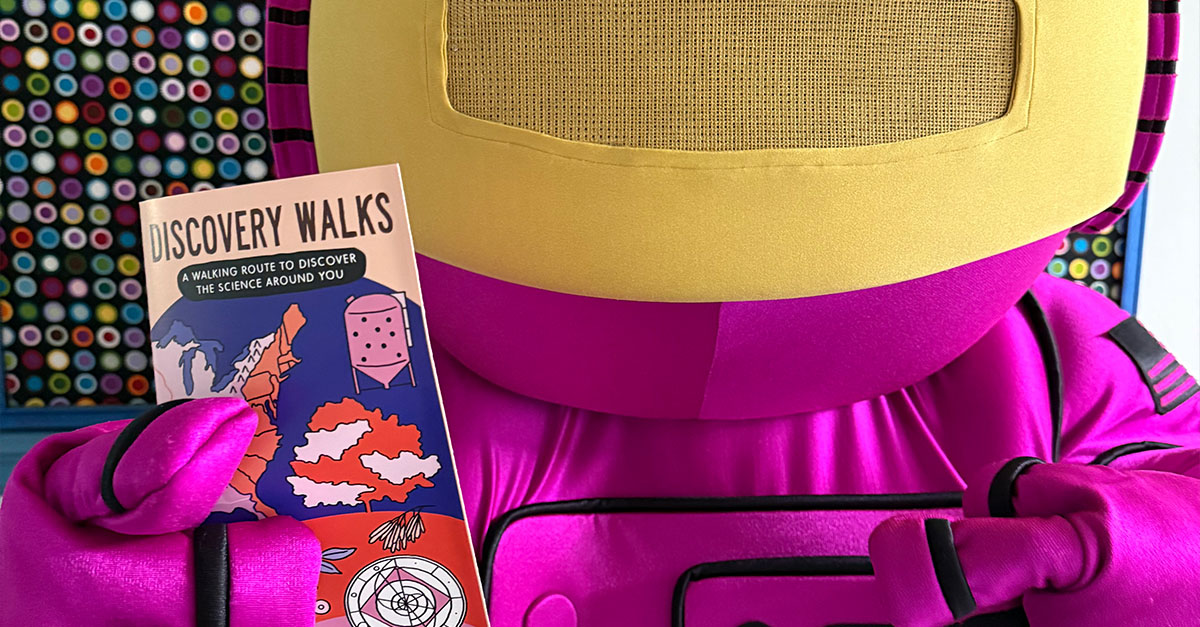
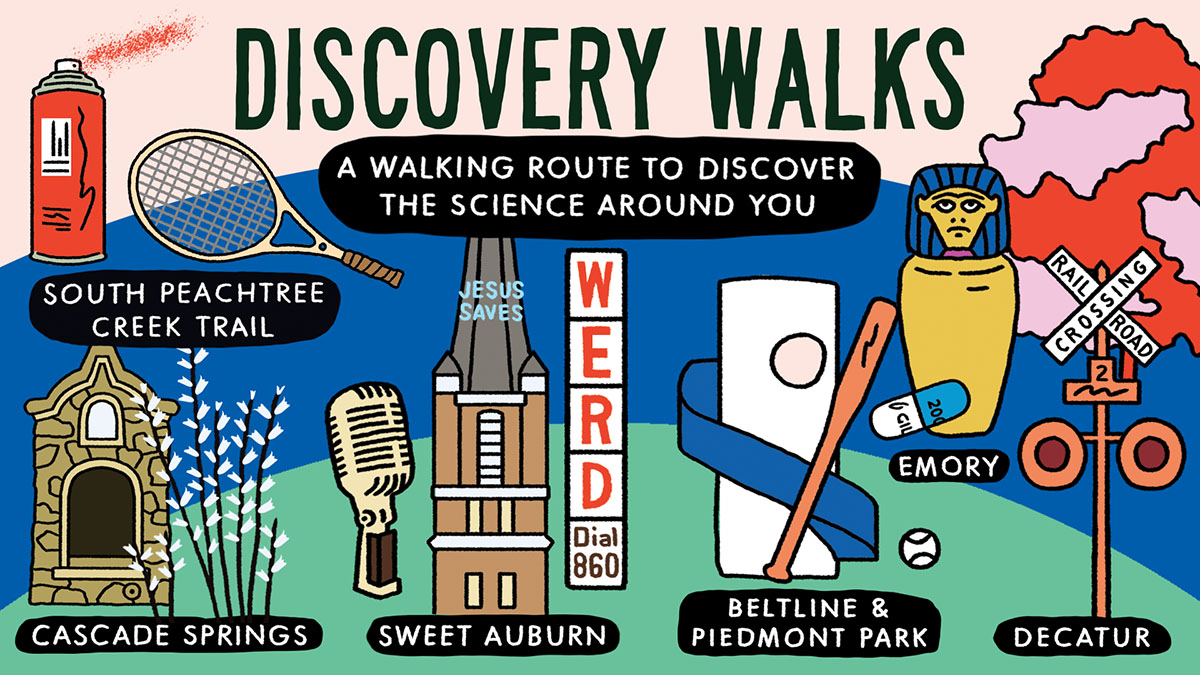
Uncover the secret science where we live, walk, and play. Science ATL’s Discovery Walks take explorers through a self-guided tour of six iconic Atlanta locales – Cascade Springs Nature Preserve, Sweet Auburn, Eastside Beltline, South Peachtree Creek Trail, Emory University, and downtown Decatur. The six Discovery Walks are presented through beautifully illustrated maps featuring family-friendly journeys between two and four miles long, each with ten intriguing science stops along the way. Pair a Discovery Walk with an eye-catching Science Y’all sticker or official Science ATL gear and you’ll have the best gift basket on the block.
Even better, make a donation to Science ATL in honor or memory of a loved one! Your gift helps support our programs and events that build a more equitable science community.
Proceeds from all these powerful presents go right back to Science ATL’s mission of cultivating an equitable community of lifelong learners across metro Atlanta connected and inspired by the wonder of science.
https://scienceatl.org/wp-content/uploads/2023/12/alex-gift-guide-1.jpg6271200Lizzi Skipperhttps://scienceatl.org/wp-content/uploads/2019/08/logo-science-atlanta.pngLizzi Skipper2025-11-25 10:51:022025-11-25 10:53:20Science ATL 2025 Holiday Gift Guide
For gift-giving this year, we’re all about experiences that make memories for you and your loved ones! Read on for ALEX’s ideas on how to add a little sprinkle of science to your holiday gift-giving.
Go Behind the Science Scene…
Give the gift of a wildlife encounter! Zoo Atlanta has lots of experiences to choose from, including encounters with pandas, lemurs, and elephants. You can also purchase a general wildlife encounter gift certificate and let your giftee choose for themselves! Or take your encounter underwater with an aquatic creature encounter for the aquarium lover in your life. Georgia Aquarium has lots of experiences to choose from, including encounters with sea lions, dolphins, and beluga whales.
Gift a Membership…to Science!
Whether your giftee likes botany, birding or building, Atlanta’s got it! A membership to the Atlanta Botanical Garden is a great gift for your favorite plant-lover that includes a nice set of benefits, including free daytime admission and discounts on educational programs. Maybe you prefer birds to plants? Try out a membership to Birds Georgia (formerly Georgia Audubon). This membership comes with access to the brand new Morgens Environmental Education Gateway: a one-stop shop for educational content focused on birds. Purchase of a gift membership includes a welcome letter, the most recent copy of Audubon’s quarterly newsletter, Wingbars, and a Birds Georgia sticker. Or perhaps your giftee is more of a doer than a watcher. In that case, give a gift membership to the Decatur Makers space! You will be shipped a membership gift certificate for your recipient. Membership comes with a key fob with 24/7/365 maker space access, access to equipment and tools, free or discounted classes, workshops, and events. Members are also allowed to bring visitors to the space!
Get Your Science Outside…
How about a “Sustainability in Action” tour with Bike Tours of Atlanta? This tour is a great way to learn more about how Atlanta has embraced sustainable practices and innovations. This experience is presented in partnership with Root Local, a local nonprofit focused on supporting collective environmental impact within metro Atlanta. Or for the nature lover, give a Georgia State Parks gift card which can be used for camping, cottage or shelter reservations, historic site admission, greens or cart fees, and retail and recreation fees. Or you can even give the gift of a year’s worth of entry into affiliated parks! Extended passes include free nights of camping, discounted lodging, and discounts on picnic shelters.
At Science ATL, we also offer maps for purchase to go on your own family-friendly science discovery walk. We partnered with a local artist to develop these six beautiful maps for you to take a self-guided Discovery Walk, each with ten intriguing science stops. Take your family and friends on a science adventure through some of the coolest neighborhoods and parks in Atlanta, including Cascade Springs, Sweet Auburn, Emory University’s campus, the South Peachtree Creek Trail, Decatur, and the Beltline & Piedmont Park. While you are purchasing some of these maps, check out our collection of shirts and stickers!
Eat and Drink Your Science…
Remember that science is everywhere! For the grown-ups in your life, consider a class about food and drink and give them the chance to ask all their nerdy questions! Elemental Spirits offers custom experiences and tastings to let you learn all about wine and cocktails. Or send your giftee to a class on how to brew the perfect cup of coffee with Opo Coffee. Opo will be hosting special classes during the Science Festival in 2024, but you can sign up for classes like Coffee Roasting Basics or Home Espresso Making anytime! Prefer to eat your science? Dig into cheesemaking with classes from Capella Cheese. You can eat your way across Europe with a wide variety of courses from these master cheesemakers!
Read Your Science…
Immerse yourself in the world of science through reading. ALEX compiled a list of books written by Georgia authors (marked with 🍑), and tossed in a few from the finalist list for the 2024 American Association for Advancement in Science/Subaru Prize for Excellence in Science Books (marked with ⭐). If you are able, stay local with your purchases. Little Shop of Stories, A Capella Books, and Virginia Highland books are some of our favorites in the metro Atlanta area.
If you love events like the Atlanta Science Festival and Science ATL LABS: Shark Dissection, please consider supporting the work we do with a donation in honor of your giftee. Your gift to Science ATL helps support our mission of cultivating an equitable community of lifelong learners across metro Atlanta connected and inspired by the wonder of science.
https://scienceatl.org/wp-content/uploads/2023/12/alex-gift-guide-1.jpg6271200Lizzi Skipperhttps://scienceatl.org/wp-content/uploads/2019/08/logo-science-atlanta.pngLizzi Skipper2023-12-04 12:19:392023-12-04 14:01:50ALEX’s Holiday Gift Guide 2023
Tis the season for science! Well, it’s always the season for science; but it’s also the time for gift giving, and why not infuse your holidays with a little local science? Check out some of our recommendations for making your loved ones’ season a little more science-y.
For the Animal Lover
Our friends at the Amphibian Foundation want everyone to see the awesomeness of amphibians. Their Master Herpetologist and Junior Master Herpetologist programs offer a 100% online way for fans of frogs, newts, and salamanders to get their feet wet in this amazing world of aquatic-based creatures. Led by experienced herpetologists, the courses are designed to be a deep dive into the world of amphibians and establish a foundation of herpetological knowledge upon which students can build.
Those looking to get a little wilder can zip on over to Zoo Atlanta for their Wild Encounters. These behind-the-scenes experiences offer attendees an up-close look at animals like the Aldabra giant tortoise, who, remarkably, can hold their breath for between 20 to 30 minutes! Guests can also get to meet and feed some of Zoo Atlanta’s perfect pandas bears. Other encounters feature lemurs, elephants, and warthogs.
For the Nature Enthusiast
A subscription to Trees Atlanta’s Acorn Club is a tree-riffic way to get kids ages six through 10 excited about the Urban Forest right in our own backyard. As a member, they’ll get four” Tree Trunk” boxes throughout the year. Each box highlights the many changes that Atlanta’s tree canopy experiences each season, along with highlighting the deeply-rooted, interconnected relationships that trees have with air, water, soil, and urban wildlife. Contents will include eco-lessons, crafts, science experiments, forest fun facts, and Trees Atlanta swag.
Make plans with plants in the heart of Atlanta’s Piedmont Park. The Atlanta Botanical Gardens has called itself the emerald jewel in the crown of Atlanta culture since its opening in 1976. “Renowned plant collections, beautiful displays and spectacular exhibitions make the Atlanta Botanical Garden the loveliest place in the city to visit,” boasts their website. “An urban oasis in the heart of Midtown, the Garden includes 30 acres of outdoor gardens, an award-winning Children’s Garden, the serene Storza Woods highlighted by a unique Canopy Walk, and the picturesque Skyline Garden.” Annual memberships, one-day tickets, and special events like their Garden Lights, Holiday Nights winter exhibition (on display November through January) are all available for purchase, as is entry to their Gainesville location, home to the largest conservation nursery in the Southeast.
Looking for something your giftee can take home? Lush Plant Co.’s plant subscription sends a four to six inch plant plus an accessory sure to make everyone green with envy. While you could purchase a subscription for a whole year, plans are also available in three-month increments, starting at just $50 a month. Lush is not only a program partner of the 2023 Atlanta Science Fest, they’re also a Decatur-based duo dedicated to curating plant selections that thrive indoors.
For the Local Explorer
Georgia has got tons of getaways all within just a few hours’ drive. A Georgia State ParkPass grants entry to dozens of properties and historic sites around the state, all of which offer stunning views, wildlife watching, and much more. While each park has its own unique draw, some of the most popular include Cloudland Canyon, with breathtaking views of Lookout Mountain in northeast Georgia, Sweetwater Creek, where you’ll find stunning scenes of a historic Civil War era-mill once featured in “The Hunger Games”, and Skidaway Island, with camping and trails along some of the Georgia’s most captivating coastlines. The Georgia State Park website also offers the chance to figure out which park matches your personality with an interactive quiz.
For some added guidance on when, where, and how to hike some of our state’s most stunning treks, consider gifting “Hiking Atlanta’s Hidden Forests: Intown and Out.” Written by Dekalb County park ranger and good friend of the Atlanta Science Festival, Jonah McDonald, the book guides the reader through 60 hikes in and around Atlanta, with the furthest being just 30 miles from the Georgia state capitol. McDonald’s offerings are great for all levels of hikers, with routes ranging from less than a mile to more than 12. Each of his listings includes maps, driving and hiking directions, GPS coordinates, and even some tips on how to get there using public transit. Bonus points if you get this book from one of our favorite local bookstores, Little Shop of Stories.
For the Bookworm
Little Shop of Stories shared a few recommendations of their own, highlighting books from local authors for every age. Got a kiddo in your life? Check out Chase the Moon, Tiny Turtle by Decatur-based author Kelly Jordan. This picture book gives young readers (and parents!) insight into the birth cycle of a loggerhead sea turtle. For older kids, Atlanta writer and scientist Rachael Allen tells the origin story of Super Villain Harley Quinn as she sets out to make a big scientific discovery and face the challenges of being a woman in STEM in Harley Quinn: Reckoning, which is perfect for both comic fans and budding scientists. As for adult readers, look no further than Emory Professor Cassandra Quave’s memoir The Plant Hunter: A Scientist’s Quest for Nature’s Next Medicines. Science ATL is thrilled to share that Quave will be hosting an event at the Atlanta Science Festival 2023.
For the Science ATL Superfan
Uncover the secret science where we live, walk, and play. Science ATL’s Discovery Walks take explorers through a self-guided tour of four iconic Atlanta locales – Cascade Springs Nature Preserve, Sweet Auburn, Eastside Beltline, and downtown Decatur. The four Discovery Walks are presented through beautifully illustrated maps featuring family-friendly journeys between two and four miles long, each with ten intriguing science stops along the way.
Pair a Discovery Walk with an eye-catching Science Y’all sticker or official Science ATL gear and you’ll have the best gift basket on the block. Better still, get your scientist into the spotlight. Now through December 31, for a $100 donation to Science ATL, you can submit a science superstar to be featured on our website gallery and receive a custom message from Science ATL recognizing their work to make sure Atlanta is a Science City.
Proceeds from all these powerful presents go right back to Science ATL’s mission of cultivating an equitable community of lifelong learners across metro Atlanta connected and inspired by the wonder of science.
https://scienceatl.org/wp-content/uploads/2022/12/Blog-Header-Gift-Guide-12.9.2022-1.png6271200Lizzi Skipperhttps://scienceatl.org/wp-content/uploads/2019/08/logo-science-atlanta.pngLizzi Skipper2022-12-09 16:05:262022-12-10 07:58:11Science ATL’s 2022 Holiday Gift Guide
Each year on December 21, darkness envelops Earth’s Northern Hemisphere for a bit longer than normal. While what we now know to be the winter solstice has a straightforward astronomical explanation, early myths of why the solstice takes place also share insights into early civilizations’ steps into science.
So, what is a solstice?
There are two solstices that occur each year – the summer solstice and the winter solstice. Both are based on the tilt of the earth’s axis in relation to the sun. All of the planets in our solar system move in a heliocentric orbit, meaning they move in a pattern with the sun at the center. But in addition to moving around the sun, each planet also rotates on its own constantly shifting axis. Here on earth, that means that the north and south poles are not straight up and down as maps might have us believe. Summer occurs in a hemisphere when its nearest pole is tilting closer to the sun, while winter occurs when the hemisphere’s nearest pole is further away.
Each year on December 21, the Northern Hemisphere is tilted the farthest away from the Sun, while the Southern Hemisphere is closer. While the overall tilt of earth’s axis during winter months can make days appear short and nights long, it is on December 21, when the winter solstice occurs and the winter season officially begins, that the Northern Hemisphere gets the least amount of daylight compared to any other day of the year.
“The Day the Sun Stands Still”
Before the modern era of telescopes and space exploration, early civilizations looked to the skies for an understanding of time, seasons, and even human existence. Many ascribed meaning to the behavior of the skies based on existing folk tales and cultural perspectives, believing the winter solstice’s lack of sunlight was caused by monsters who stole the sun away. Some cultures also saw the solstice as an opportunity to create light, or goodness, in the face of darkness, or evil.
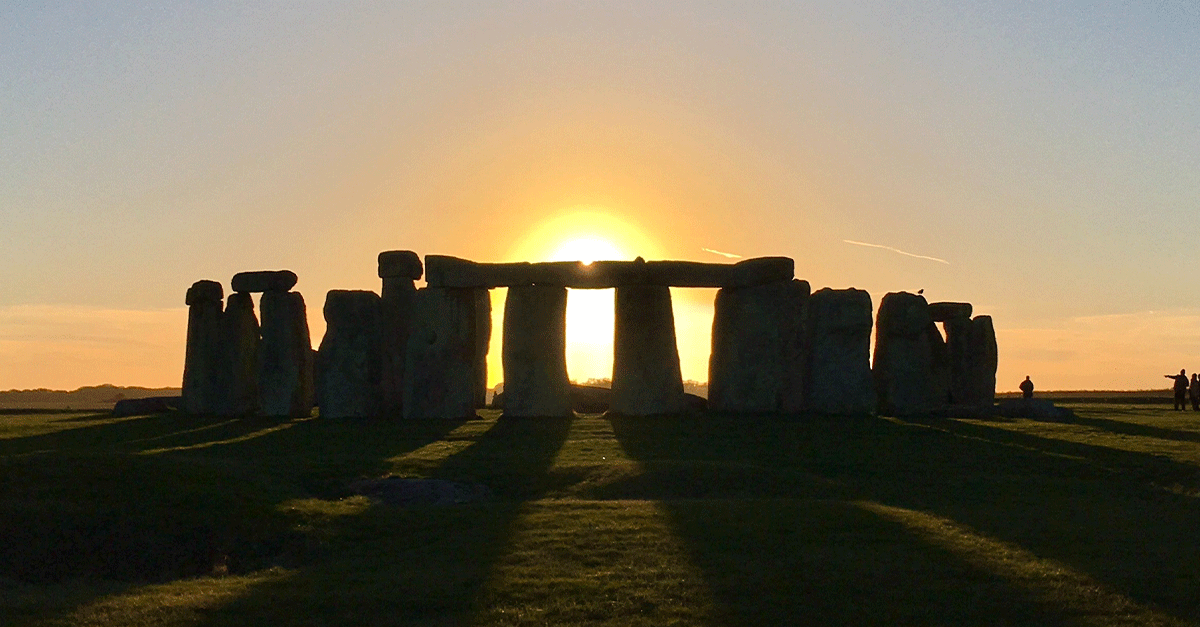
History indicates that humans may have been observing the solstice since the Neolithic period, around 10,200 BC. In the Stone Age, people held rituals at sacred sites like England’s Stonehenge, Ireland’s Newgrange, and Native American Woodhenge in what is now known as Illinois, in celebration of the changing seasonal cycle.
In Finnish folklore, the winter solstice was believed to be the work of Louhi, the “witch goddess of the North”, who kidnaps the sun and moon, while both Yupik and Greek early explanations thought the solstice afforded gnome-like creatures the opportunity to hunt.
But the solstice isn’t scary in all cultures. For many, the day is a chance to worship a number of religious deities, like Tonantzin in Mexico, Cailleach Bheru in Scotland, Horus in Egypt, and Spider Grandmother by the Hopi. The winter solstice is also frequently associated with earth’s rebirth, as it emerges from the long night to the light of day, as well as the continual cycle of life and death. The Scandinavian Goddess, Beiwe, for example, is associated with health and fertility and was believed to travel through the night sky in a sleigh-like structure of reindeer bones with her daughter, Beiwe-Neia, to bring back the greenery on which the reindeer fed. In Italian folklore, La Befana is a witch who spends the solstice night riding around the world on her broom, leaving candies and treats to well-behaved children.
Events like the Pagan Scandinavian Feast of Juul, Pakistani Festival of Chaomos, Chinese Dongzhi Festival, and Roman Pagan Saturnalia, to name a few, are all also associated with lighting up the darkness that occurs on and around winter solstice. These occasions, and the stories associated with them, were powerful tools intended to not only explain what people of the time believed to cause the winter solstice, but also to reassure that the darkness would pass, daylight would return, and joy, or light, would prevail.
Mythical Meaning as a Scientific Method
The word “solstice” is derived from the Latin words “sol”, meaning “sun”, and “sistere”, or “to stand”. Just as varying cultures use language as a tool for communication, societies of the past also used legends as a way to share understandings about natural phenomena.
While we now know that it is planetary positioning that causes the winter solstice, it is still delightful to view this day of darkness as a chance to cozy up and look forward to the light in seasons to come.
https://scienceatl.org/wp-content/uploads/2022/12/Blog-Header-Solstice-12.10.png6271200Lizzi Skipperhttps://scienceatl.org/wp-content/uploads/2019/08/logo-science-atlanta.pngLizzi Skipper2022-12-01 21:43:182022-12-10 08:00:57Science of the Solstice: Why the Winter Solstice is an Astronomical Wonder to Behold
As a child growing up just south of Atlanta in Mountain View, she watched as the steady expansion of Atlanta’s airport slowly took over her neighborhood. The constant roar of jets made Mountain View one of the most noise-impacted neighborhoods in the world; as the airport continued to grow, residents slowly sold their homes to the airport planning agency and left. Soon the city itself was dissolved, removing a physical place from the map but leaving behind a vibrant, if dispersed, community.
The town of Mountain View wasn’t the only thing taken over by the relentless expansion that made Hartsfield-Jackson the busiest airport in the world and transformed Atlanta into a global city. Buried beneath the mammoth airport – under the fifth runway, to be exact – is a tributary of the Flint River, which runs almost 350 miles through Georgia until it joins the Chattahoochee River and flows into the Gulf of Mexico.
Palmer first discovered the Flint River when researching her book Flight Path: A Search for Roots Beneath the World’s Busiest Airport. The book chronicles her search for what became of the community she grew up in – one almost entirely displaced by the growth of the airport.
The history of Palmer’s community echoes that of the Flint River, which has also been overshadowed and buried – literally – by the development of the airport. Even as the airport brought enormous benefits to Atlanta, providing jobs and connecting us to the world, it also threatened to erase the very things that connect us to the place we live.
Palmer now seeks to restore connections between the physical space the airport occupies and the communities that surround it. She sees herself as a storyteller, preserving and sharing the things that make our home more than just a physical place. Science is a central character in these stories, a constant presence in the intimate connections between physical places, the natural world, and the things that make us human. “I love to hear people who remember baptisms, or some urban legends or rites of passage that involve [the Flint River],” she says. “I love to think about times when it was more connected to our lives.”
Finding the Flint
Her research led her to Finding the Flint, a project dedicated to protecting and raising awareness of the Flint River created by American Rivers, The Conservation Fund, and the Atlanta Regional Commission. Part of Finding the Flint’s mission is to build awareness of the natural world and how it influences our communities – a task inextricably connected to science.
Indeed, Palmer sees science as a key element in creating safer infrastructure, building a sense of place, and working toward environmental justice. “How do we clean up this river? What do we do with this landfill? How do we develop alongside this runway or this highway? We can’t turn our backs on these places – they’re not isolated from the rest of the city.”
Palmer’s role at Finding the Flint is one of a science communicator, community organizer, and coalition builder. She works with scientists, engineers, architects, and planners, bringing together stakeholders from environmental groups and local governments to airport planners and Delta Air Lines. The group hopes to work with regional and airport planners to make the airport more than just an engine for economic growth, but also the basis for a thriving community – a place of its own, not just a place people pass through to get somewhere else.
The group works to more deeply involve the public in the health of our watersheds, sponsoring scavenger-hunt-like tours of Flint tributaries, cleanups in the often-overlooked natural areas surrounding the airport, and outreach to airport-area employees. A recent weekend found Palmer organizing the Southside River Rendezvous, where participants learned how to collect water samples, then scattered across Atlanta to sample water quality in dozens of creeks. Finding the Flint hopes that these types of events better connect the public with the people and organizations who advocate for the health of their watersheds, and help build awareness of the natural resources that we often take for granted.
Ultimately, Palmer sees science as a key tool in building connections between people, places, and the environment. “It’s going to be scientists who help solve these problems – who design technologies to extract contaminants from the soil, who design technologies to detect air pollution and noise pollution. These are the landscapes that we’ve inherited, and there’s a huge opportunity to think differently.”
https://scienceatl.org/wp-content/uploads/2021/12/science-flint-river.png6271200Lizzi Skipperhttps://scienceatl.org/wp-content/uploads/2019/08/logo-science-atlanta.pngLizzi Skipper2021-12-06 10:35:482022-05-13 10:06:13Uncovering Stories of Science in the Flint River
After Dr. Yomi Noibi wrote a newsletter article about toxic chemicals in waterways, the previous Executive Director of Environmental Community Action (ECO-Action) tore it up. Dr. Noibi had written the article following the usual practice taught by his extensive scientific training – a PhD in environmental science from the University of Iowa followed by teaching positions at the University of Wisconsin, the University of Lagos, and Clark University – and he had given equal weight to the communities affected and the companies producing toxic chemicals. And that’s where he had gone wrong. Most publications tended to center the companies and rarely the people affected. “We have to write our own story,” says Noibi, ECO-Action’s current Executive Director.
“Community” is central to the name for a reason: ECO-Action focuses on helping people living in disenfranchised areas across Georgia and changes priorities based on community needs. In Taylor County, they shifted from pollution-fighting to political organizing when residents told ECO-Action that there hadn’t been a local election for ten years. Many volunteers, including Noibi, worked with local organizers and outside legal experts to push for an election in a community- and Black-led initiative. This shift in goals required bringing in new expertise, ECO-Action’s specialty. According to Noibi, the key step in organizing is to “connect people to people that can bring about change.”
And bring about change they did. The combined efforts of Taylor County citizens, lawyers, and ECO-Action resulted in an election, and the voters elected the first few African Americans to the Taylor County Board of Commissioners, ensuring that the board demographics better reflected that of the county. The new board members could then act on environmental issues.
Learning Together
Organizing is always a learning process. No one person or field could have addressed all the problems in Taylor County, but a coalition of people with different backgrounds and skills had a major impact. ECO-Action does not market itself as the entire solution: it’s simply the catalyst that makes these connections, and then everything else, happen.
The importance of learning from others applies beyond doctors, lawyers, and scientists. ECO-Action hosts discussion groups for different generations of Atlanta area residents to discuss local concerns together. Dr. Noibi says that these groups are founded with the idea that everyone, from a six-year-old to her grandparents, has an important perspective on their living environment and issues present in it, and that only through learning from each other can action occur. In Dr. Noibi’s words, “We have to work and learn together. First we have to learn together. Then we have to work together.”
ECO-Action Programming
Many participants in ECO-Action’s programs, such as the Intergenerational Learning Group and the Community Watershed Learning Group, mention their surprise that environmental concerns are only part of the program. A training or discussion group isn’t solely about sewage leaks, or tire dumping, or floodwater management. “It’s about injustice,” says Noibi. “It’s about thinking outside the box, because you cannot address environmental problems with the current framework of thinking.”
Part of the shift outside of this current framework needs to be legal. In alleged water contamination, the people affected often are legally required to demonstrate the presence of pollutants. This, emphasizes Noibi, is unfair for many reasons. First, the people living in a contaminated area may not have access to pollutant testing or the money to pay for it. Second, some chemicals may be toxic in smaller amounts than current laws suggest, and the health consequences of other pollutants may not yet be clear. Lead from water pipes, for example, was considered safe at one time. Most importantly, the burden of proof falls unjustly on the people impacted, who already suffer health damage from pollution. The brutal reality is, says Noibi, that at the end of the day, “we’re the ones exposed, we’re the ones burying the body.”
The other important step towards a more just world lies in the perception of science. Scientific training emphasizes a “science as solution” mindset at the expense of considering how science results are used. A more just outlook, suggests Noibi, would involve thinking “that science is the answer, no. Science is a tool to help get the answer. The answer is in the people.”
https://scienceatl.org/wp-content/uploads/2021/12/environmental-action.png6271200Lizzi Skipperhttps://scienceatl.org/wp-content/uploads/2019/08/logo-science-atlanta.pngLizzi Skipper2021-12-06 10:35:412022-02-22 10:50:37Environmental Action, One Community at a Time
While science and humor appear to be mutually exclusive fields, Dr. Lew Lefton, Faculty in the Department of Mathematics and Associate Vice President for Research Computing at Georgia Tech, has bridged these two seemingly distant worlds by performing science comedy and investigating the science of comedy.
Lew began performing standup as a hobby while a graduate student in the 1980s, just as cable television roused a public love for comedy. “As a performer,” Lew says, “you’re there to serve the audience.” Catering to his audiences from the scientific community and the public, his sets highlighted aspects of both his professional career and what was then an emerging hobby. Today, Lew continues to bridge these two passions, making science the subject of his comedy; “Comedy is the noun; science is the adjective.”
The Science of Comedy
All the time spent crafting science comedy led Lew to become increasingly interested in the inverse relationship between the two: comedy science, a field still relatively unstudied. Some who study the subject propose that comedy is unique to humans due to psychological phenomena associated with humor. For example, humans demonstrate theory of mind—or the ability to consider the perspective of others—but there is debate as to whether (and the extent to which) other animals exhibit this cognitive ability.
Comedy often relies on theory of mind; the comprehension of another’s point of view can help an audience understand the humor in a comedian’s story or a comedian recognize whether the audience might find a joke too offensive or outdated. It’s these complex cognitive abilities that may prove humor to be the ultimate Turing test, as they can’t be coded precisely through machine learning. However, progress in this research is difficult without a way to measure and quantify humor.
What Makes Comedy Funny?
Lew and his colleagues—including Georgia Tech faculty member Dr. Pete Ludovice—have worked to address this obstacle through the Humor Genome Project. As their database of humor-related content grows, so does their ability to perform quantitative analyses on various components of humor. The science of comedy has already boasted important results–including benefits of humor in coping with anxiety and depression–and has potential findings in numerous areas such as human health and social behavior.
One group already jumping into these data are Lew’s students; he offers a project-based data analytics course at Georgia Tech in which students analyze data on humor from the Humor Genome Project. This creative approach to studying machine learning, computational analysis, and theories of behavior and cognition has great promise for gaining a better understanding of the science behind comedy.
“Things that make you laugh and then think—that’s the sweet spot.”
Beyond illustrating the relationship between science and comedy, Lew also emphasizes the ways it can benefit both comedians and scientists. He suggests that comedians take note of the science around them; not only can they benefit from understanding the science of comedy but understanding science will only give them a more informed voice to use on their platform. Scientists, on the other hand, should not only consider comedy another tool for telling their research story but also a great form of entertainment to enjoy. After all, anyone can benefit from a good laugh—there’s science to prove it! As for his personal take on what makes for great comedy, he suggests, “…things that make you laugh and then think—that’s the sweet spot.”
How to Get Involved in Atlanta Comedy
Atlanta has a rich comedy scene with a diverse array of opportunities for performing. Though joining the comedy scene as a first-time performer may seem daunting, Lew recommends learning by doing! Fortunately, Atlanta offers opportunities for aspiring comedians to practice in both improv classes and open mic nights. If you’re not up for being in the stage lights, numerous Atlanta venues offer comedy shows. Science for Georgia offers comedy events that will let you sit back and enjoy the humor in science and comedy.
Thank you to Lew Lefton for sharing his time and expertise on comedy! You can see more about Lew Lefton’s work here and explore his impressive collection of April Fool’s jokes here.
https://scienceatl.org/wp-content/uploads/2021/08/comedy-of-science.png6271200Lizzi Skipperhttps://scienceatl.org/wp-content/uploads/2019/08/logo-science-atlanta.pngLizzi Skipper2021-08-31 16:38:442021-12-10 13:30:15The Comedy of Science
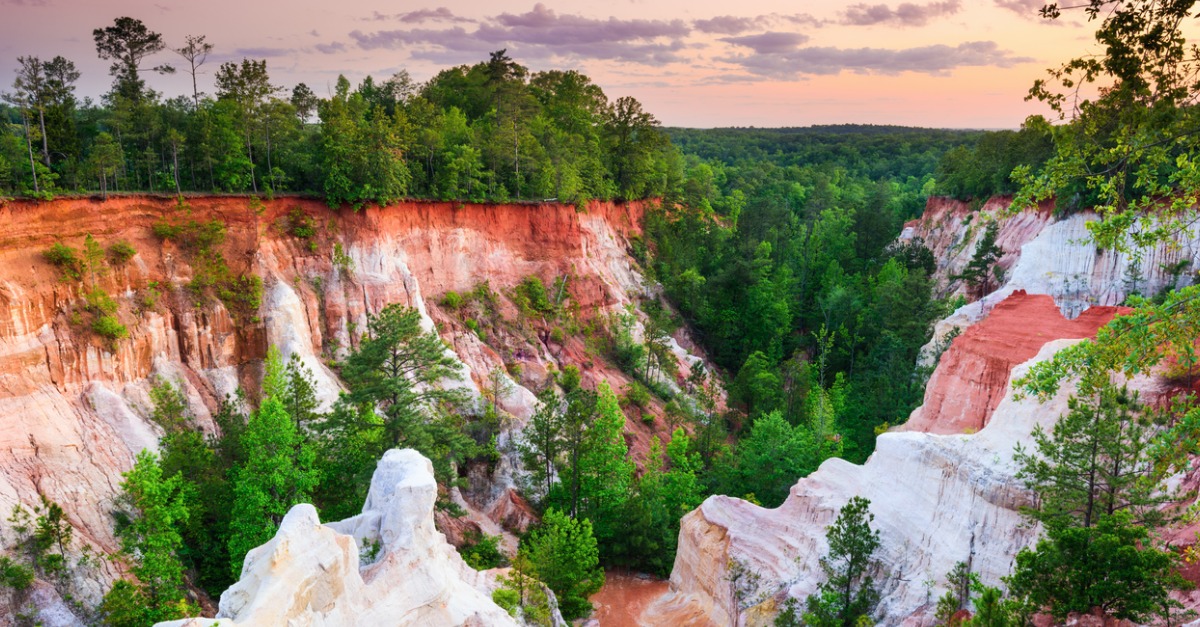
You are standing in the middle of a deep deep canyon. It has everything it needs to flourish: water, soil, sunlight, and air. There are wild boars at the water table, huge trees, even alligators! Can you believe this magical wonder would not have been possible without humans making reckless decisions while trying to survive?
A Trip to the 1830s
Let’s go back in time. Imagine yourself in the 1830s and what you see is just open land. Land that is ready to be farmed. There are a few trees, so you decide to cut them, you know, for more land to farm. Neighbors mostly grow cotton to support their families, so you decide to farm cotton too. Over time, you notice that cotton just doesn’t grow the same way it did years before, but you don’t worry too much, maybe the soil just has a short lifespan. You decide to go to another piece of land and cultivate cotton there. You move to a piece of land that is uphill because you have learned over the years that cultivating crops on a slope allows more water to get into the soil.
What was happening to the soil wasn’t normal, and science explains why not. When you are farming (or in this case over-farming), you are removing the topsoil. The topsoil contains the most important nutrients for crops to grow: metals, microbes, and minerals. It also becomes “loose,” so it can be more easily carried away by wind or rain. When these get carried away, the crop won’t get the necessary nutrients and stops producing.
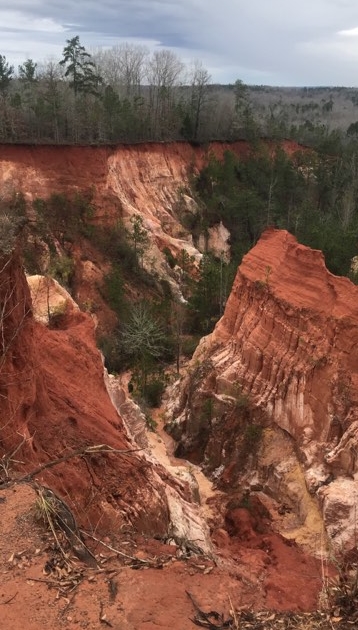
Decades of soil erosion formed Providence Canyon in Lumpkin, GA
Loose Soil Leads to Erosion
As the land becomes “ungrowable,” a second phenomenon occurs. Erosion is the geological process where inner earth materials are worn away by natural forces. In this case, rain and bad farming practices washed away bits and pieces of soil and sand. Little by little over the course of two centuries, the effects of this became visible in the development of a deep canyon appearing on the old farmland. 43 different colors of soil, layers, and layers going into the inner earth. So much soil was taken away that it cannot go any deeper, it ends at the water table.
The rainwater is removing soil at different rates depending on steepness. Remember when you were farming cotton on a steep slope? Well, it led to erosion happening from all sides, and if you look at the deeper and deeper parts of the earth you will see that there is one color in common: red-orange, and this indicates the presence of the metal iron (Fe) because it gets dissolved as water travels through the sediment, then it oxidizes (unites with oxygen), and it’s precipitated at different depths staining the soil in different colors.
The History of Providence Canyon
Now flash forward to today. All of this happened in a small town in Georgia called Lumpkin. The farming was improperly managed during that time, and unfortunately, Providence Canyon formed in a few decades due to the erosion and the overcropping that happened. Thankfully, we are now aware of the damages we were doing to the environment. President Jimmy Carter bought the land in 1970 and established it as a 1,000-acre conservation area. A lot of trees were planted, and this land regained a little bit of its former lush beauty. Trees reduce the amount of storm runoff, which reduces erosion, and they also serve as food and shelter to many organisms. Through conservation, plants and animals began to thrive in Providence Canyon.
One of Georgia’s Natural Wonders
Providence Canyon is one of the “natural” wonders of Georgia. It has much resemblance to the Grand Canyon out west. If you haven’t had a chance to visit, you should! And remember that those red colors and imperfect surfaces happened because of the damage many human practices do to the earth. Despite its beauty, the history of Providence Canyon is also a reminder that if we remove vital elements of earth, we must also take steps to protect it from future damage.
https://scienceatl.org/wp-content/uploads/2021/08/providence-canyon-georgia-picture-id537361252.jpeg6271200Lizzi Skipperhttps://scienceatl.org/wp-content/uploads/2019/08/logo-science-atlanta.pngLizzi Skipper2021-08-02 13:58:492021-08-02 13:58:49Georgia’s Little Grand Canyon: Providence Canyon
Ever wanted to make something, but weren’t sure how or where to start? Don’t have the tools? Afraid of making mistakes? Not sure what a makerspace is or how to be part of one? Don’t panic!
There is a dedicated place in the metro Atlanta area where anyone can discover and channel their inner creativity and bring ideas to fruition –Decatur Makers! Decatur Makers is one of the few family-friendly and all-ages makerspaces in Georgia. It was founded in 2012 and is housed in a refurbished old gym that was previously a roller-skating rink. I recently met with Irm Diorio, the Executive Director (Maker in Charge?) at Decatur Makers, to learn more.
What exactly is a makerspace?
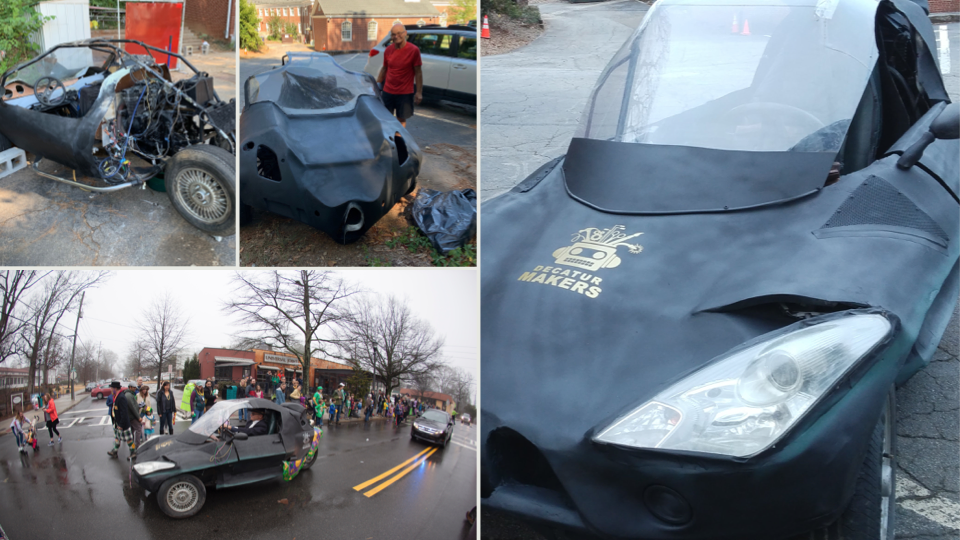
According to Irm, “a makerspace is a playground for your creativity, a space to learn, build, innovate, try new things, and make mistakes. Most important of all it is a community of people”. One member, Steve Freant, took this to heart and built a car at Decatur Makers using recycled materials! With the help of fellow members at Decatur Makers, Steve learned skills such as metalwork in order to bring his grand vision to reality.
A hobbyist woodworker with a background in marketing and advertising, Steve got attracted to metalwork because he did not have to wait for pieces to dry. He tapped into the vast experiences of other members at Decatur Makers who were only eager to share their expertise. Steve is now on a mission to build his second car at Decatur Makers!
“A makerspace is a playground for your creativity, a space to learn, build, innovate, try new things, and make mistakes.”
Images of the Stevemobile, created by Freant with the help of several members at Decatur Makers.
Perhaps not as difficult as finding the answer to the “Ultimate Question of Life, the Universe, and Everything”, building a car, let alone driving it in Atlanta, is not always an easy task. It takes dedication, and a willingness to learn. Makerspaces provide community space to turn creative dreams into reality.
So, you have an idea?
Decatur Makers lives its mission: “Empowering people to create and learn through hands-on experiences that positively impact their lives and communities” in its daily operations. Whether you are just starting out, merely curious, or an expert, Decatur Makers welcomes you. According to Irm, “Everybody is a maker … but we’re not just about the making of things, we’re about making a difference. Making fosters life-changing experiences where kids and adults find passions, learn hard skills, and develop and strengthen the soft skills of problem-solving and critical thinking.
Image credit: Maureen Haley
This type of success positively impacts people of all ages by empowering them in all areas of their life.” The process takes time and often requires experimenting with different approaches and developing multiple versions. However, a sense of curiosity and lots of patience can lead to a more refined result that not only solves the initial problem but also provides insights into solving similar problems. The making journey continues as community members share their knowledge with one another.
In its 8 years of operation, Decatur Makers has used this model of continual improvement and made quite an impact in the Atlanta community and beyond. The story goes that it all started when some local Decatur kids needed a place for their robotics team to practice. A few parents, prompted by Decatur Makers founders Garrett Goebel and Lew Lefton, took it a step further and thought a place where a diverse group of kids and adults could use tools and work together to learn skills and build things would be a great resource for our community. Years later, their idea has blossomed into a maker community that supports the learning, creating, and innovating that comes with making all kinds of things.
From idea to product and product to more ideas
If you have a solid idea (the idea can also be in shaky liquid form or vague gaseous form) of what you want to create, do not hesitate to get to the drawing board and reach out to the maker community for help, advice, or anything you need to bring that idea to fruition. Decatur Makers features a fully equipped wood shop, an electronics shop, and a metal shop. They also have an array of 3D printers, a Glowforge Pro laser cutting/engraving system, a CNC milling machine, a HAM radio station, a microbiology lab, sewing machines, arts and crafts equipment, leather crafting tools, and a 4-color screen printing system.
Feeling overwhelmed? Don’t panic! Decatur Makers also offers a variety of introductory classes such as Woodshop 101, Intro to 3D Printing, Glowforge 101, Metal Lathe 101, Wood Lathe 101, and Welding Machine Basics.
Who let the dog out?
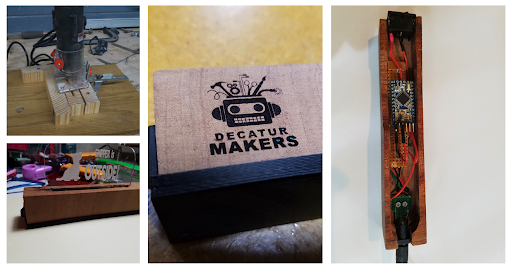
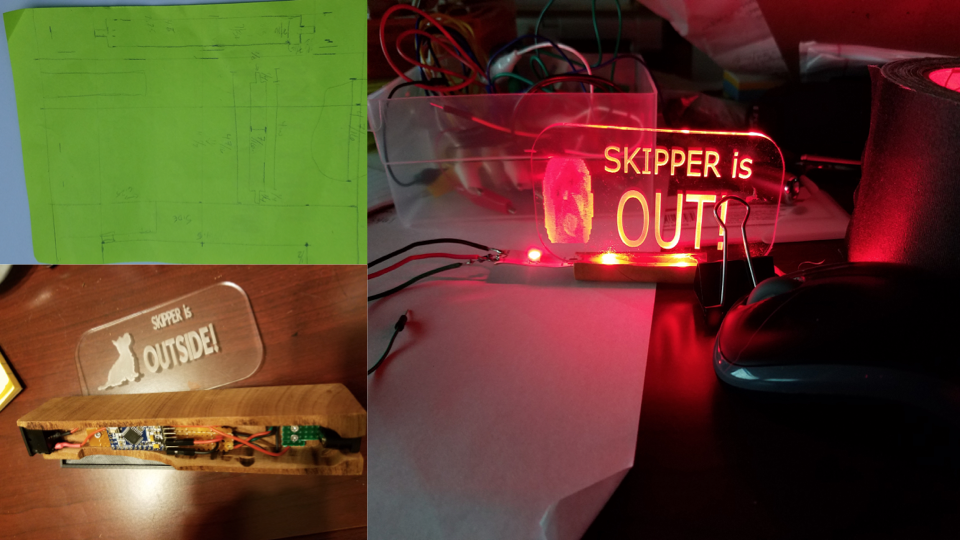
Maureen applied several techniques such as laser cutting, woodwork, 3D printing, and electronics to make her alert system.
Another maker, Maureen Haley, has witnessed first-hand the importance of having a community where individuals can start from basics, tap into the experiences and wisdom of peers, make something they are proud of, and share the knowledge with others. Around 2012, Maureen was trying to learn some programming skills so she could build projects with her new Arduino beginners kit from Adafruit.com. This endeavor led her to two amazing opportunities.
First, she signed up for what was then MITx’s initial Massive Open Online Class about Circuits and Electronics, which dramatically opened her mind to resources available to adult learning online. Second, she came across a suggestion online to look for local hackerspaces on Meetup.com. This led her to a nearby group meeting, which was the early gatherings of Decatur Makers. At this meeting, she met Irm Diorio, and together they “started building a thriving, open-source, magical community of do-it-yourselfers, closet instructors, brilliant creatives and enthusiastic makers.” One of her proudest accomplishments at Decatur Makers is a top-notch monitoring system that she created to alert her brother whenever his dog, Skipper, snuck outside the house.
Maureen’s path to creating the most ingenious DIY pet alert system started right after Decatur Makers acquired a Glowforge laser cutter and started offering introductory/safety classes. The laser cutter became popular among makers who would often use the free software Inkscape to create a luggage tag or key chain fob with their name on it. While Maureen was waiting for her turn to upload a tag and practice using the machine, she picked up some scrap acrylic that was lying around the makerspace and designed a small engraving with a dog on it. (Unfortunately, when she uploaded a picture of Skipper, the details were not as distinct, so she opted for a silhouette of a dog that resembled Skipper). She then took her laser-cut piece of acrylic home and wired up some LEDs to make the light shine through. Next, she supported the engraving, using wood as a base. The next challenge was connecting all the components together!
Maureen’s pet alert system, from sketch to functional product.
Being a recent graduate of Decatur Makers Woodshop 101 class, she made a jig to guide a handheld router and created a recess on the bottom of a dark wood chunk that a fellow maker had donated, to hold a strip of lights, and another recess on top to hold the piece of acrylic. Maureen then ingeniously connected a power jack to a piece of protoboard, wired up an on/off switch, programmed a microcontroller, and engraved the Decatur Makers logo onto the wood! She queried the woodshop community for oil coating recommendations to keep the wood from drying out and give it a rich color. Finally, to cover the bottom where the electronics were, she used a free program called Tinkercad to design a small lid/tray and printed it on the 3D printer at Decatur Makers.
By the time she was done, Maureen’s project was a complete tour of the makerspace – laser cutting, woodwork, electronics, and 3D printing. Besides providing her with the resources she needed to help her brother track his furry friend’s movements, Decatur Makers made it possible for Maureen to use tools like laser cutters and 3D printers that she otherwise would have had to buy. Moreover, she benefited from other makers who were ever ready to share their skills.
How to get involved with Decatur Makers
At Decatur Makers, everyone, regardless of interests or skill levels, is welcome to join a vibrant and growing community of makers. Throughout the year, Decatur Makers hosts a variety of events such as the weekly informal Maker Happy Hour and Open Build Night that are open to anyone interested in learning more about makerspaces or sharing about a project they have worked on. Decatur Makers also organizes classes such as papermaking, stained glass making, woodworking, 3D printing, and laser cutting. You can check out their class offerings, public events, or donate to support their operations athttps://decaturmakers.org/. If you have never visited, check out their virtual tour on YouTube (https://youtu.be/IQDuVG61NSI).
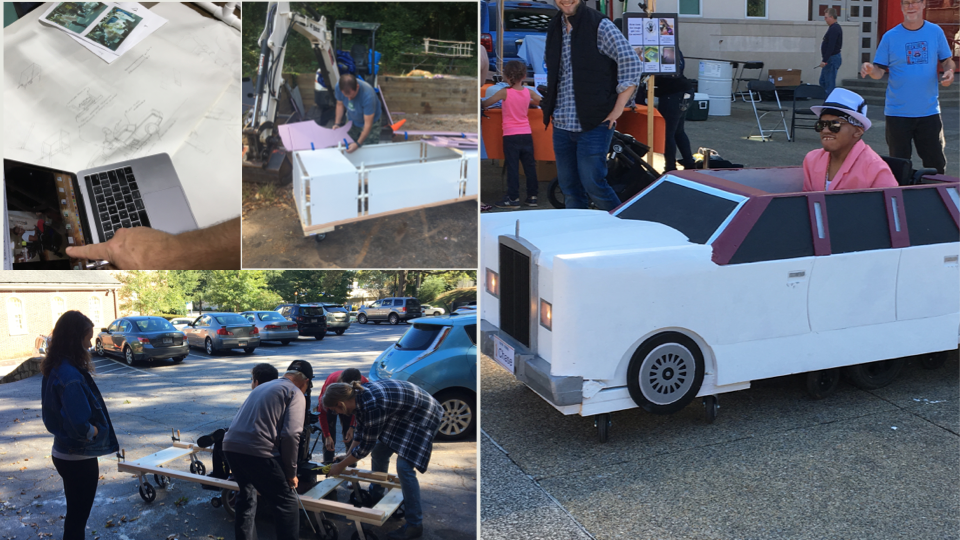
Decatur Makers fitted Chase as Bruno Mars in a 1985 Lincoln Town Car Stretched Limousine.
Decatur Makers has also partnered with various other nonprofit organizations, institutions, and makerspaces. Under the Atlanta Beats Covid initiative, Decatur Makers partnered with other makerspaces and volunteers to create Personal Protection Equipment (PPE) to curb shortage in the state of Georgia. “We are always looking for community partners because we’re only as rich as the people we work with,” said Irm.
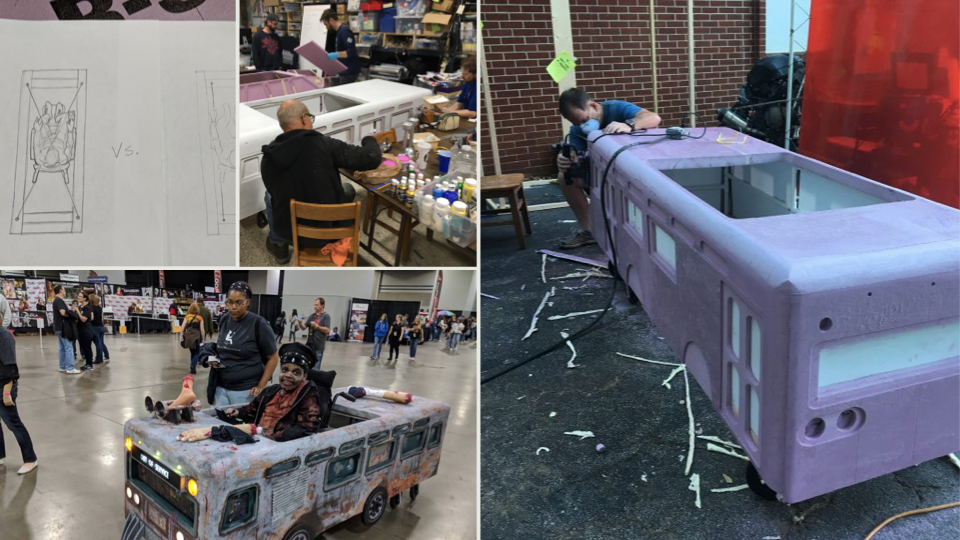
In 2018, Decatur Makers partnered withMagic Wheelchair, a nonprofit organization that builds “epic costumes for kiddos in wheelchairs — at no cost to families”, to create TWO amazing Halloween costumes for two metro Atlanta kids – Chase and Armani. Chase dressed as Bruno Mars from the Uptown Funk video (complete with wheelchair transformed into a 1985 Lincoln Town Car Stretched Limousine) and Armani dressed as a zombie on the bus from Black Ops 2 (Call of Duty).
Decatur Makers also fitted Armani as a zombie on the bus from Black Ops 2 (Call of Duty).
Many thanks to Irm Diorio for highlighting all the amazing work being done at Decatur Makers. Thanks also to Steve and Maureen for sharing about their work!
https://scienceatl.org/wp-content/uploads/2021/04/guide-to-the-makerspace.png6271200Lizzi Skipperhttps://scienceatl.org/wp-content/uploads/2019/08/logo-science-atlanta.pngLizzi Skipper2021-04-30 13:16:332021-04-30 13:17:42The Hitchhiker’s Guide to the Makerverse!
Ernest Ngirimana, MBA, serves as Chief Financial Officer for Emory Healthcare’s Physician Group Practice, overseeing financial strategy and performance for the Physician Division. With extensive experience in healthcare finance, Ernest previously held CFO and senior leadership roles at Temple Health, Oishei Children’s Hospital, UPMC, and Allegheny Health Network, driving significant revenue growth and operational improvements. Recognized as a “40 Under Forty” honoree by the Philadelphia Business Journal, he holds an MBA and Bachelor’s degree from Duquesne University and is an active member of ACHE and HFMA. Ernest is widely respected for his strategic vision, collaborative leadership, and commitment to health equity and institutional growth.
What wows you about science?
I am always wowed by how science can always explain the why and how behind everything we touch, see, feel, and even think.
 By Misael Romero-Reyes